How Many Fish Can I Put in a 10 Gallon Tank?
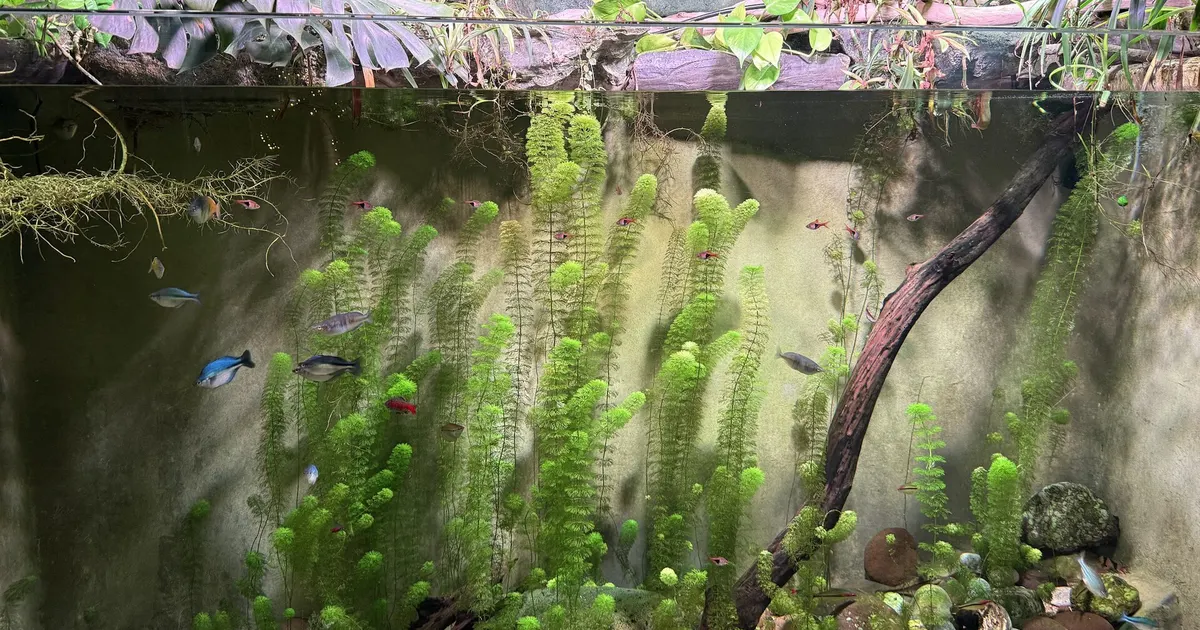
There is no single correct number of fish for a 10 gallon tank. How many fit depends on how big each species gets as an adult, how active it is, whether it needs to live in a group, and how well your filter and maintenance keep up with the waste. The honest way to answer it is to pick the species first, check each one’s minimum tank size and group size, and then add fish slowly while you test the water.
Start by knowing how much water you really have. Our aquarium volume calculator works out the full volume of your tank and the actual water left after the gap at the top and the gravel, which is always less than the number on the box.
Why “1 inch of fish per gallon” falls short
The old rule says one inch of adult fish per gallon of water. It is easy to remember, but it is only a very rough starting point, and it goes wrong in a few common ways:
- Body shape. A long, slim fish and a deep, heavy-bodied fish of the same length produce very different amounts of waste.
- Adult size, not shop size. Fish are usually sold young. The rule only means anything if you use the length the fish will reach as an adult.
- Swimming space. Fast, active swimmers need room to move along the length of the tank, not just a share of the water.
- Social needs. Schooling fish need to be kept in a group to feel secure, so you cannot just add “one more”.
- Territory. Some fish defend space, and a small tank gives the others nowhere to go.
Use the rule as a sense check at most. The species’ own needs come first.
What really limits a 10 gallon tank
Real water volume
A tank sold as 10 gallons holds 10 gallons only when it is filled to the brim with nothing in it. Once you leave a gap at the top and add gravel, rocks and wood, there is less water. The calculator uses the tank’s inside measurements and these formulas:
- Full volume in US gallons = length × width × height (in inches) ÷ 231
- Real water = length × width × (height − gap − gravel depth) ÷ 231
One US gallon is exactly 231 cubic inches. The calculator starts with a 1 inch gap and 2 inches of gravel, and you can change both to match your tank. Rocks and decorations take up a little more space again.
Waste and filtration
Every fish adds waste, which breaks down into ammonia. In a cycled tank, helpful bacteria in the filter and gravel turn ammonia into nitrite and then into nitrate, which you remove with water changes. The more fish (and the bigger they are), the more work the filter and your water changes have to do. A small tank has less water to dilute mistakes, so problems build up faster.
Adult size and swimming room
This is where most 10 gallon tanks go wrong. Some fish commonly sold in small sizes grow far too big for a tank this size. Common goldfish, plecos and many cichlids are examples. Always look up the adult size before you buy.
Temperament and groups
Check whether a species is peaceful, whether it is a schooling fish that needs a group, and whether it gets along with the other fish you plan to keep. A fish that needs a group should only go in if the tank can hold the whole group.
How to plan your stocking, step by step
- Measure the tank. Measure the inside length, width and height in inches and enter them, plus the gap and gravel depth, in the aquarium volume calculator. Use the real water figure from here on. Our guide to how many gallons your fish tank holds covers common tank sizes and shapes.
- Make a short list of species. For each one, look up its adult size, minimum tank size, group size, temperament and preferred temperature in a reliable species profile.
- Cross off anything that does not fit. If a species’ minimum tank size is bigger than your tank, or it needs a bigger group than you can house, it is not a good match.
- Check the fish suit each other. Look for the same temperature and water needs, and no fish that will bully or eat the others.
- Cycle the tank first. Run the filter until the tank can process ammonia and nitrite before adding fish. A water test kit shows when this has happened.
- Add fish a few at a time. Add a small number, wait, and test for ammonia and nitrite. Add the next fish only when the readings stay at zero.
- Leave room. Stop short of the most you think will fit. A lightly stocked tank is far easier to keep stable.
Equipment for a small tank
- Filter: sized for the tank volume, with gentle flow if your fish are small or slow swimmers.
- Heater: most tropical fish need one. Our aquarium heater calculator works out the wattage from the tank size, using the common 5 watts per US gallon rule and a safer two-heater option.
- Thermometer and test kit: check the temperature every day, and test the water regularly, especially after adding fish.
- Lid: many small fish can jump.
Common mistakes
- Stocking by the shop size of the fish instead of the adult size.
- Adding all the fish on day one, before the tank is cycled.
- Counting the label volume instead of the real water after gravel and decor.
- Buying one of a schooling species because there is “room for one”.
- Skipping water changes because the tank is small. Small tanks need steady maintenance.
If a fish looks sick, stops eating or behaves oddly, test your water first, then check with your vet. Many vets treat fish, and some specialize in aquatic animals.
Frequently asked questions
How many fish can I put in a 10 gallon tank?
There is no fixed number. It depends on the adult size of each species, whether it needs a group, its temperament and how well your filter and water changes handle the waste. Choose species whose minimum tank size is 10 gallons or less, add them gradually and test the water as you go.
Does the one inch per gallon rule work?
Only as a very rough check. It ignores body shape, adult size, swimming space and group needs, so it can allow far too many fish of some kinds. A species’ own minimum tank size and group size are a better guide.
Can a goldfish live in a 10 gallon tank?
Common goldfish grow large and produce a lot of waste, so a 10 gallon tank is too small for them as adults. Check the adult size and minimum tank size of any goldfish variety before buying, and expect to need a much bigger tank.
How much water is really in my 10 gallon tank?
Less than 10 gallons, because of the gap at the top, the gravel and any decorations. Measure the inside of the tank and use the aquarium volume calculator, which subtracts the gap and gravel depth to show the real water volume.
How fast can I add fish to a new tank?
Only after the tank is cycled, and then a few at a time. Test for ammonia and nitrite after each addition, and wait until both read zero before adding more. If either rises, do a partial water change and hold off on new fish.