What Size Heater for a 20 Gallon Tank?
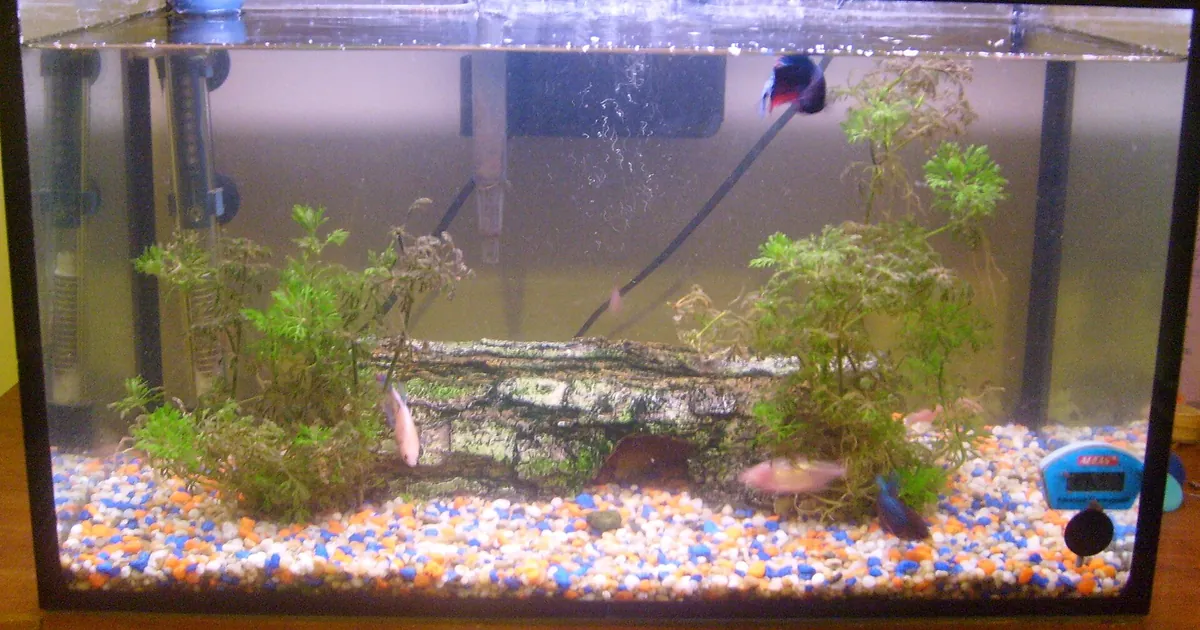
For a 20 gallon tank, the standard rule of 5 watts per US gallon gives 100 watts, so a single 100 W heater is the usual pick. A more cautious approach keeps the total at 3 watts per gallon or less and splits it over two heaters, which for 20 gallons means two 25 W heaters. The aquarium heater calculator runs both rules for any tank size.
The two sizing rules
The standard rule: 5 watts per gallon
Most heater makers size their heaters at about 5 watts per US gallon, or about 1.3 watts per liter. The sum is:
Heater watts = tank gallons × 5
For a 20 gallon tank, that’s 20 × 5 = 100 W. Heaters come in common sizes, and the calculator rounds up to the next one: 10, 25, 50, 75, 100, 150, 200, 250 or 300 W. Since 100 W is a standard size, that’s the heater it suggests.
The safer rule: 3 watts per gallon, split over two heaters
Aquarium Science, a fishkeeping reference site, argues that 5 W per gallon is more power than most tanks need, and that a heater that sticks “on” can overheat a tank quickly when it is that powerful. It recommends:
Total heater watts ≤ tank gallons × 3, split between two heaters
For 20 gallons, the limit is 20 × 3 = 60 W in total, so each heater can be up to 30 W. The calculator picks the largest common size that fits under that, which is 25 W, giving 2 × 25 W.
Two heaters do two jobs. If one sticks on, it has less power to cook the tank. If one fails off, the other keeps the water from getting cold while you replace it.
Which setup should you choose?
Both setups are reasonable, and the right one depends on your tank and your room.
- One 100 W heater is simple, cheap to set up and takes up less space. It warms the tank quickly after a water change. Choose a good-quality heater with a reliable thermostat.
- Two 25 W heaters cost a little more and take more space, but they give you a safety margin and a backup. They also spread heat more evenly if you put one at each end.
Things that push you toward more heating power:
- A cold room, such as a basement or a room that’s cool in winter
- Keeping fish that need much warmer water than the room
- An open-top tank, which loses heat through the surface
Things that mean you need less:
- A warm room that stays near the temperature your fish need
- A tight lid, which keeps heat in
If you’re not sure, the standard 100 W heater with a separate thermometer is the common choice. Check the care sheet for your fish to see what temperature they need, and set the heater to match.
Is my tank really 20 gallons?
Many tanks sold as “20 gallons” come in two shapes: a “20 long” and a “20 high”. Both hold about the same amount, so the heater size is the same. Real water volume is usually a bit less than the label, because of gravel, decorations and the gap at the top, but heater sizing uses the tank’s rated size.
If your tank has no label, measure the inside length, width and height in inches and use:
Gallons = length × width × height ÷ 231
The aquarium volume calculator does this for rectangular, round, hexagon and corner tanks, and our guide to how many gallons your fish tank holds explains the steps.
How to set up and place the heater
- Read the heater’s instructions first, especially the minimum water line. Many heaters must be fully under water; some must never run out of water.
- Put it where water flows, such as near the filter outlet, so warm water spreads through the tank.
- Fit it at an angle or upright as the maker suggests, clear of gravel. Don’t bury it.
- Let it sit in the water for a while before plugging it in if the instructions say so, so the glass can adjust to the water temperature.
- Set the temperature your fish need.
- Add a separate thermometer at the other end of the tank. Check it every day, because heater dials aren’t always accurate.
- Unplug the heater before water changes if it isn’t rated to run out of water.
Common mistakes
- No thermometer. The heater’s dial is not a measurement; a thermometer is.
- Buying the biggest heater “to be safe.” A heater that’s much too powerful is the one that can overheat a tank fastest if it sticks on.
- Placing it in a dead spot with no water flow, which leaves one end warm and the other cool.
- Ignoring the room. A heater that’s fine in summer may struggle in a cold room in winter.
Tips
- Pick the stocking with the heater in mind. Before adding fish, read how many fish you can put in a 10 gallon tank; the same steps work for a 20.
- Use a heater controller if you want an extra safety cut-off. It shuts the heater off if the water gets too warm.
- Keep a spare heater if you go with a single one, so a failure doesn’t leave the tank cold.
Frequently asked questions
Is a 100 watt heater too much for a 20 gallon tank?
No, 100 W is the standard size for 20 gallons at 5 watts per gallon. The thermostat switches it off once the water reaches the set temperature. If you’d rather keep the total power lower, two 25 W heaters stay within the 3 watts per gallon limit.
Can I use a 50 watt heater for a 20 gallon tank?
It is below the standard rule but within the more cautious 3 watts per gallon limit. Whether it’s enough depends on how much warmer than the room you need the water. In a warm room it may be fine; in a cold room it may run all the time and still fall short. Watch the thermometer for a few days.
Where should I put the heater in a 20 gallon tank?
Near the filter outlet or another spot with good water flow, so the warm water mixes through the tank. Keep it clear of the gravel and follow the maker’s minimum water line. Put the thermometer at the opposite end.
Do I need two heaters for a 20 gallon tank?
You don’t have to. One 100 W heater is the standard choice. Two smaller heaters are a safety upgrade, giving you a backup and less risk if one sticks on. The aquarium heater calculator shows both options for your tank.